
Loading...
Serving St. Cloud, FL and surrounding areas. (689) 214-9340
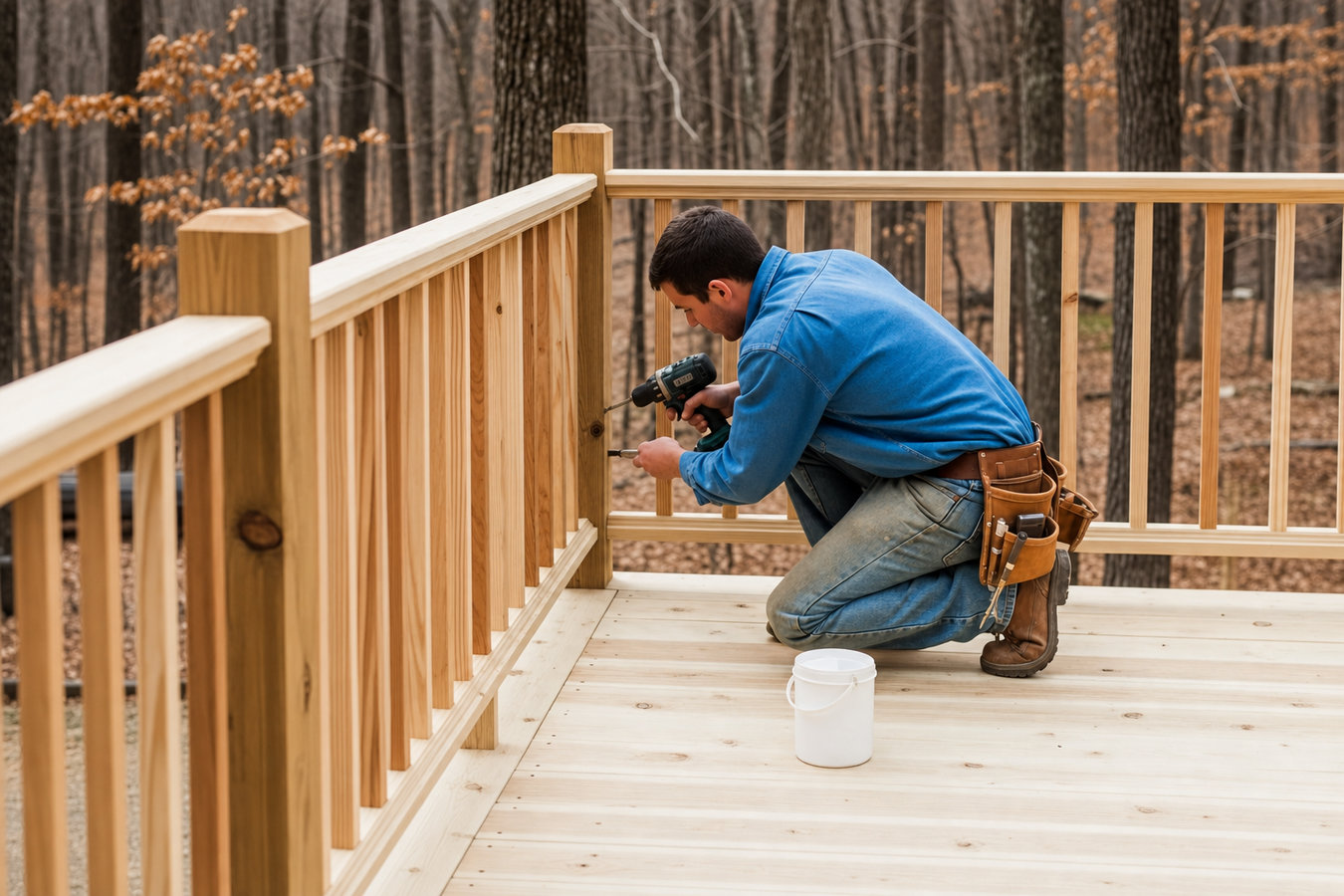
A railing that wobbles is a hazard, not a feature. We install deck railings that meet Florida safety standards, handle the Osceola County permit, and hold up through years of heat and storm season.
Deck railing installation in St. Cloud means anchoring posts through or into the deck framing, attaching top and bottom rails, and filling with balusters or panels - most standard residential projects are completed in one to two days once the permit is in hand.
In Florida, any deck that sits 30 inches or more above the ground is required by law to have a railing. That is not just a style choice - it is a safety rule that protects your family and guests from a fall that could cause serious injury. And in St. Cloud's market, a deck that does not meet current railing requirements can complicate a home sale or draw a flag from your insurance provider if something goes wrong.
If you are replacing old railings on an existing deck or adding them to a structure that was built without them, the process is straightforward - but it still requires a permit and county inspection. If you are building a new deck at the same time, railing work is part of every project we complete, whether it is a standard build or a fully custom deck design.
Stand at the edge of your deck and push firmly against the railing with both hands. If it shifts, wobbles, or feels loose at the base, the posts are no longer anchored securely. This is a safety issue - a railing that moves under pressure can fail completely when someone leans against it. In St. Cloud's climate, wood post bases that have been sitting in humidity and rain are especially prone to this problem.
Press a screwdriver into the base of a wooden post - if it sinks in easily or the wood crumbles, the structural integrity is gone. Florida's year-round humidity is hard on wood railings, and rot that has reached the post base cannot be fixed with paint. Replacing the railing with a material better suited to this climate - aluminum or vinyl - is usually the right call at that point.
If your deck sits 30 inches or more above the yard and does not have a railing, it does not meet current Florida safety requirements. This matters for your family's safety and for your homeowner's insurance. Adding a railing brings the structure into compliance and gives you real peace of mind whenever guests or children are outside.
Older decks - especially those built before Florida updated its building standards - sometimes have balusters spaced far enough apart that a small child could slip through or get stuck. If you can fit your fist through the gap, the spacing does not meet today's requirements. Replacing the balusters is a straightforward fix that makes a real difference in safety without replacing the whole railing system.
We install railings in aluminum, vinyl, composite, cable, and glass - each material with a different look, maintenance level, and price point. For most St. Cloud homeowners, powder-coated aluminum and cellular vinyl are the top choices because they resist the moisture and UV exposure that wear down other materials in this climate without requiring annual painting or sealing. Composite railings offer a wood-like appearance with similar low-maintenance benefits. Whatever material you choose, every railing we install is anchored with posts bolted through the deck framing - not just surface-mounted on top of the decking boards - because through-bolted posts are significantly stronger and hold up to Florida wind loads. If you are having the whole deck replaced at the same time, we can coordinate railing selection with the overall project through our deck repair and replacement service.
For homeowners who want a more modern look, cable railing systems use stainless steel cables run between posts to create an open, unobstructed view of the yard or pool. Glass panel railings achieve the same open feel with a more formal appearance. Both options require more precise installation and are priced higher than aluminum or vinyl, but they are popular in St. Cloud's lake-area neighborhoods where homeowners want to preserve sightlines. Every railing installation we complete is permitted through Osceola County and includes the county inspection to confirm it meets Florida's height and spacing safety requirements. You can see the full range of materials and how they fit into a larger deck project on our custom deck design and build page.
Best for St. Cloud homeowners who want maximum durability with minimal upkeep - powder-coated aluminum resists rust, UV fading, and Florida humidity without painting.
A low-maintenance option with a clean, painted look that holds up well in Florida's climate - popular in HOA communities where consistent appearance matters.
Looks like painted wood but resists moisture and UV damage far better - a good choice for homeowners who want a traditional aesthetic without constant upkeep.
Stainless steel cables between posts for a modern, open look that preserves views of the yard or water - popular in lake-area and pool-adjacent settings.
Frameless or framed glass panels for a premium, unobstructed look - more involved to install but highly popular where views are a priority.
For decks where the frame is still sound but the railing is worn, loose, or outdated - we replace the full railing system with minimal disruption to the rest of the structure.
St. Cloud's average annual humidity regularly exceeds 70 percent and summer temperatures routinely climb into the low 90s. That combination is genuinely hard on outdoor materials - moisture gets into the grain of wood, and heat causes expansion and contraction that loosens fasteners over time. Homeowners here tend to get longer life out of aluminum, vinyl, or composite railings than they would from painted wood, which is why we steer most clients toward materials built for this climate rather than ones that look good on day one but need work within a few years. Florida's building code also requires that structures in this region handle significant wind loads - a railing that looks fine on a calm day but was not properly anchored can become a hazard during the tropical storms that pass through the area each summer. We anchor every post through the deck framing, not just to the surface, and the county inspection confirms the finished work holds to that standard. Homeowners in Harmony and similar HOA communities also need to factor in their association's rules about railing materials and colors before any work begins.
Many of St. Cloud's newer subdivisions - including communities near Narcoossee Road and along the East Lake Toho corridor - are governed by HOAs with architectural guidelines that specify what railing styles and colors are permitted. Getting county approval is not always enough; HOA sign-off before installation begins prevents costly changes after the fact. We ask about HOA requirements at the first estimate visit and help you choose materials that satisfy both sets of requirements from the start. For homeowners near Kissimmee and the broader Osceola County area, the same local permit and HOA considerations apply. For guidance on wood and material performance in Florida's specific climate, the University of Florida IFAS Extension publishes research on exactly this topic.
When you reach out, we ask a few basic questions - the size of your deck, your current railing situation, and whether you have HOA restrictions. We reply within one business day. You do not need to know what material you want before you call - that is part of what we help you figure out.
We visit your property to measure the perimeter, check the condition of the existing deck structure, and look at how the deck is attached to your home. We walk through material options - what holds up best in Central Florida's climate, what fits your budget, and whether your HOA has requirements. A written estimate follows.
Before any work begins, we pull a building permit from Osceola County. This typically takes a few business days to a couple of weeks depending on the county's current workload. You do not need to do anything during this phase - we handle the paperwork and will let you know when the permit is in hand.
Most standard railing projects are completed in one to two days. We remove the old railing if there is one, anchor new posts through the deck framing, attach top and bottom rails, and install balusters or panels. After installation, the county inspects the work. We walk the finished railing with you before we leave - push on it, check the gaps, make sure everything looks right.
We handle the Osceola County permit, schedule the inspection, and give you a written quote covering everything before work starts - no surprises on the final bill.
(689) 214-9340A railing is only as strong as the posts that hold it. We bolt posts through the deck framing rather than surface-mounting them on top of the decking boards - which is the only method that produces a railing that genuinely does not move when someone leans against it. This is especially important for Florida wind loads.
We recommend powder-coated aluminum and cellular vinyl because both materials are specifically engineered for high humidity, intense UV exposure, and the salt air that affects coastal Osceola County properties. The University of Florida IFAS Extension documents exactly how Florida's conditions affect different outdoor materials - and the data supports these choices.
We pull the Osceola County permit before work begins, coordinate the post-installation inspection, and ask about your HOA requirements at the first visit. Many St. Cloud homeowners have been surprised to learn their subdivision requires written HOA approval before a railing replacement can proceed - we catch that early so there are no delays or violations after the work is done.
Before we remove a single baluster, you have a written quote that covers materials, labor, permit fees, and cleanup. The number on that quote is the number on your final invoice. Homeowners can verify Florida contractor licenses at the Florida Department of Business and Professional Regulation - we carry an active license and are happy to provide it upfront.
A properly installed railing should feel completely solid - no flex, no wobble, no gaps that were not there by design. That is the standard we hold every job to, and the county inspector confirms it before we close the permit. You can learn more about current deck railing standards from the North American Deck and Railing Association.
If you are starting from scratch or replacing an entire deck, our custom design service covers layout, materials, and railings as one complete project.
Learn MoreWhen the existing deck structure needs work alongside the railing, we assess the full condition of the deck and address framing, boards, and railings together.
Learn MoreWe handle the Osceola County permit and inspection from start to finish - contact us today and get a written quote before any work begins.